/Logo%20Oxycom/Logo%20Oxycom%20-%20blue.png?width=207&name=Logo%20Oxycom%20-%20blue.png)



/Case%20studies%20(Pictures)/VCN/Oxycom%20-%20Clauger.jpg?width=900&height=900&name=Oxycom%20-%20Clauger.jpg)
/Case%20studies%20(Pictures)/Equinix/PreCooll%20adiabatisch.jpg?width=1400&height=1050&name=PreCooll%20adiabatisch.jpg)
/Case%20studies%20(Pictures)/M%20and%20G/Sustainable%20cooling%20and%20heating%20M%26G.jpg?width=700&name=Sustainable%20cooling%20and%20heating%20M%26G.jpg)
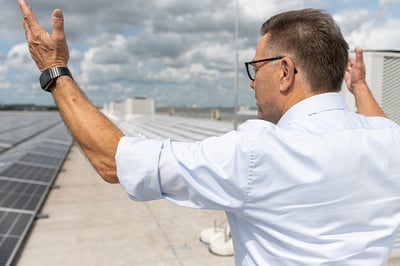
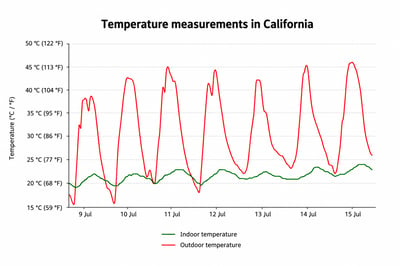
Over the past decades, the global climate has changed noticeably. Temperatures once considered exceptional now occur much more frequently across many regions. This is particularly evident every summer in industrial facilities struggling with working climate challenges: overheated halls, machines continuously releasing heat, employees becoming fatigued more quickly, rising absenteeism, and processes running less smoothly under high temperatures.
International studies and industry reports confirm this picture: a significant share of employees are exposed to high workplace temperatures for many hours each year. The effects are not limited to individual comfort but also impact productivity, quality, and business efficiency. At the same time, the pressure to attract and retain skilled workers is increasing; a comfortable and healthy working climate is becoming an increasingly decisive factor.
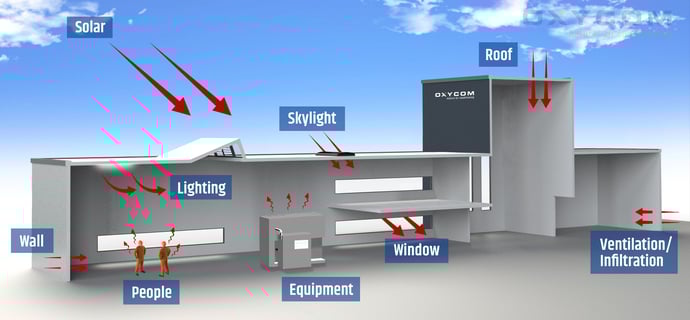
Main heat-load sources in an industrial building include solar gain, the roof and walls, lighting, people, equipment, windows and ventilation or infiltration.
Kor Foekens - Commercial Director Oxycom: I have been working with industrial adiabatic cooling for almost 20 years, including seven years at Oxycom. During this time, I have supported hundreds of industrial projects, from bakeries to production environments with high heat loads. Based on this practical experience, I can confidently say that two-stage adiabatic cooling is currently the most future-proof form of industrial cooling.
Not only because the technology demonstrably performs better as outdoor temperatures rise and heat loads increase, but especially because our customers confirm this in real-world applications. Companies that have switched from direct adiabatic cooling or mechanical cooling experience more stable indoor temperatures, lower energy costs, and greater operational reliability during heat peaks.
In other words, we build on a proven foundation and enhance it with additional control and performance. In this article, I explain why more and more companies are choosing two-stage adiabatic cooling systems and the measurable benefits they see in daily operations.
Why industrial refrigeration systems should be reconsidered
Rising outdoor temperatures and the growing pressure to save energy are placing industrial cooling systems under increasing strain. Mechanical cooling is often not cost-effective in many production environments due to high energy consumption, large hall volumes, significant heat loads, and intensive air-exchange requirements.
Direct adiabatic cooling has long been a practical solution, but it reaches its limits at high outdoor temperatures. At that point, a few degrees of cooling are no longer sufficient, and attempts to increase cooling performance can quickly lead to excessive humidity introduction. This can create risks for products and processes, for example, in paper, metal, or food production.
Two-stage adiabatic cooling offers a well-balanced solution: typically 4 to 7 degrees deeper cooling than direct adiabatic systems, on average 50 to 70 percent less moisture introduction, and up to 92 percent lower energy consumption compared to mechanical cooling.
The advantages of two-stage adiabatic cooling
1. Instantly lower energy costs and CO₂, without compromising on cooling
For industrial companies, sustainability is no longer a side project but a clear requirement. At the same time, the demand for efficient cooling continues to grow. Anyone relying exclusively on mechanical systems today accepts high energy consumption and a higher CO₂ footprint. Two-stage adiabatic cooling demonstrates that there is another way: in practice, energy savings of often 80 to 92% can be achieved. This is also reflected in the experience of companies such as Heemskerk Fijnmechanica, where owner Lucien Heemskerk summarizes:
"The system is environmentally friendly, energy efficient and the working climate in the hall is pleasant."
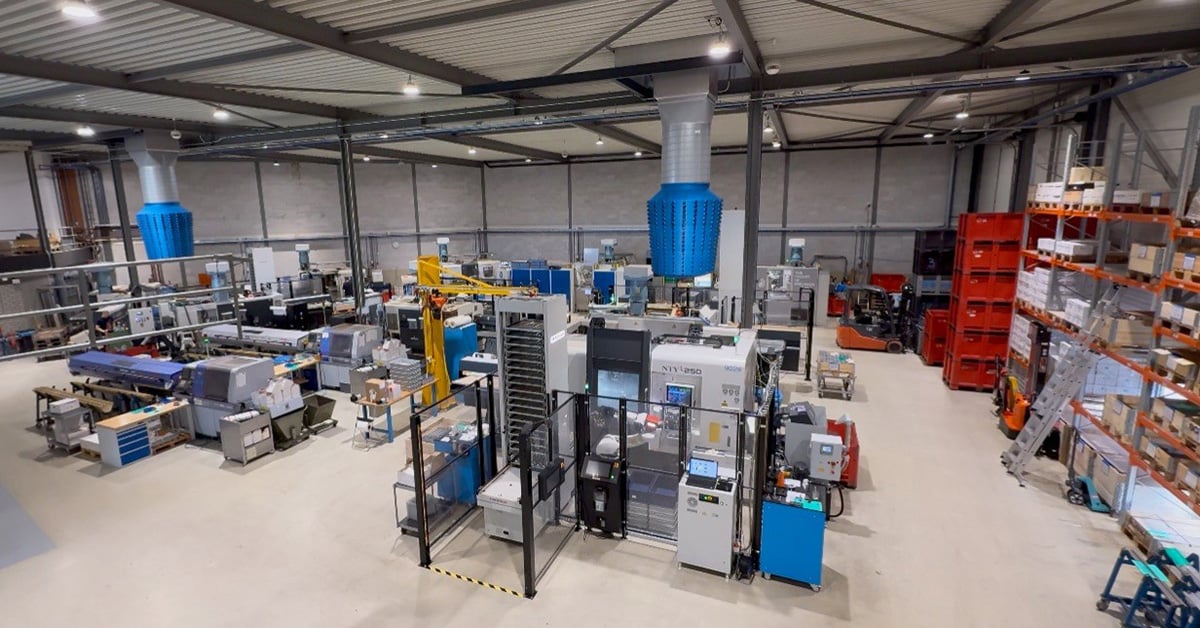 Case study: Heemskerk Fijnmechanica benefits from lower energy consumption thanks to Oxycom's IntrCooll.
The physics are also clear, especially when considering energy consumption across the entire electricity supply chain. One cubic meter of water that completely evaporates provides 695 kWh of cooling capacity. Compare this to mechanical cooling, where roughly 200-250 kW of electricity is required to deliver around 700 kW of cooling capacity. If you also take into account that electricity generation operates at only about 40 to 50% efficiency and that power plants use large amounts of water for heat dissipation, the total water and energy consumption of mechanical cooling is often three to four times higher than that of two-stage adiabatic systems. In addition, this type of system eliminates the use of F-gases, synthetic refrigerants with a strong global warming potential.
What this means for you: a noticeably lower energy bill, reduced CO₂ emissions, and a cooling solution that seamlessly aligns with the requirements modern industry faces today.
2. Noticeably more comfort on the shop floor, even on the hottest days
You can feel a good working climate immediately. Two-stage adiabatic cooling operates in summer with 100% fresh outdoor air that is introduced at low level. The air absorbs heat inside the space and then carries it outside.
In addition, the air can be distributed more precisely, allowing specific zones to be cooled. In practice, this translates into better “air quality” on the shop floor: less stuffiness, less humidity, and often less fatigue at the end of the working day.
At 247TailorSteel, this was clearly stated after installation. Carl Berlo, CEO of 247TailorSteel, speaks about Oxycom’s IntrCooll system:
“After installing Oxycom’s systems, no one talked about high indoor temperatures anymore. It simply works. The temperature is stable and the space feels comfortable and well ventilated. Our employees are now very satisfied with the indoor climate.”
This is a response I get back more often once companies make the move to two-stage adiabatic cooling: comfort becomes predictable, even when it's extremely hot outside.
/Case%20studies%20(Pictures)/24%20Tailorsteel/Nieuwsbrief%20247TailorSteel.png?width=1067&height=667&name=Nieuwsbrief%20247TailorSteel.png)
Case study: Two-stage adiabatic cooling makes a difference at 247/Tailor Steel.
3. High efficiency: more cooling capacity per kWh, less energy waste
Two-stage adiabatic cooling combines high thermal efficiency with a relatively simple system design.
A motor-driven fan consumes approximately 1 kWh of electricity and delivers up to 40 kWh of cooling capacity. In comparison, conventional air conditioning systems use 1 kWh and typically provide around 3 kWh of cooling capacity.
On hot days, this can work even more to your advantage. When conditions are favourable for evaporation, cooling capacity increases without a proportional rise in energy consumption. The two-stage technology of Oxycom can therefore achieve 4 to 7 degrees of deeper cooling than direct adiabatic systems, while introducing less moisture.
4. Easy installation and maintenance, less complexity on site
The system consists of an air handling unit with filters and water, without complex compressors or refrigerants. No F-gas certification is required, which simplifies installation and maintenance.
Installers often report that the system is surprisingly easy to install. Existing air handling units and ventilation systems can often be reused. In many situations, the system can also be added as a pre-stage to existing installations, helping keep investments manageable and maintaining an attractive payback time.
/Case%20studies%20(Pictures)/Van%20Merksteijn/PXL_20251211_092718744.RAW-01.COVER.jpg?width=8160&height=6144&name=PXL_20251211_092718744.RAW-01.COVER.jpg) Easy installation of Oxycom's IntrCooll.
Easy installation of Oxycom's IntrCooll.
5. Controlled humidity, no stuffy air, but a healthy indoor climate
A common complaint about conventional air conditioning is dry air, which can cause irritated eyes and a scratchy throat. In overly dry air, comfort can decrease and people may experience more irritation.
Two-stage adiabatic cooling works differently. The system does not dry out the air but helps create a pleasant indoor climate with healthy humidity levels. This is often perceived as “fresher” air, which can help reduce discomfort.
While direct adiabatic cooling is sometimes associated with excessive humidity, two-stage technology shows that moisture levels can be better controlled. By intelligently regulating supply air temperatures, relative humidity can often be maintained around 60 percent. This is relevant for comfort, product quality, and process reliability.
In industrial processes, there is an additional advantage: humidity can be adjusted to meet production requirements. In paper, plastics, and metal processing, this can help reduce static electricity, lower dust levels, prevent flash rust, and minimise unwanted material deformation.
6. Versatile use across almost every industry, especially where it gets really hot
Two-stage adiabatic cooling is particularly effective in bakeries, large production halls, logistics centres, and workshops. In these types of spaces, the energy costs of conventional cooling systems can rise quickly.
That is why more and more companies in sectors such as metal processing, logistics, packaging, and food production are choosing this solution. In processes such as printing, plastics processing, or metalworking, heat, gases, vapours, and dust are released. The system refreshes indoor air several times per hour. Heat and polluted air are actively extracted, while fresh, filtered, cooled air is evenly supplied to the shop floor.
Even in winter, the system can add value with the heat reclaim module. Warm air that accumulates near the ceiling is recirculated back to the working zone. In addition, fresh cold outdoor air can be mixed with recovered heat, allowing fresh air supply at a comfortable inlet temperature without additional energy consumption using technology from Oxycom.
7. Hygienically designed and proven safe in operation
Hygiene in water-based cooling systems is a valid and important concern. Therefore, it is essential to clearly explain the conditions under which legionella can develop. This only occurs when water remains stagnant for an extended period, warms up (typically above about 25°C), and is then dispersed through airborne droplets (aerosols).
The units are designed to avoid these risks. The IntrCooll system works with contact humidification, where water flows over specially developed evaporative material with HydroChill Fin Coating. No droplets or aerosols are released into the room; the air passes along the material surface while cooling occurs through contact evaporation. Thanks to deep cooling performance, water temperature remains below 20°C.
Water does not stay inside the unit for more than one day. The system is drained at least once daily, and the evaporative material is dried. The units are certified according to the latest VDI 6022 hygiene standards and therefore meet stringent safety requirements..png?width=1000&height=600&name=VDI%206022%20(met%20witruimte).png)
Practical experience and proven customer satisfaction
Personally, what convinces me the most is customer feedback. Companies that initially used direct adiabatic cooling and later switched to two-stage systems consistently report being especially satisfied with the improved performance at higher outdoor temperatures and the greater predictability in comfort and air quality.
Our website features multiple references and case studies of manufacturing plants and logistics centers that benefit daily from a stable, comfortable and energy-efficient indoor climate. Those case studies are consistent with what we technically see and measure under similar conditions.
Choose stability and reliability in your climate control
Cooling demand is increasing; the climate is changing, energy is becoming scarcer, and grid congestion is putting pressure on power availability. In this reality, two-stage adiabatic cooling is not an experiment but a proven solution. Based on my experience, this system delivers strong performance across comfort, sustainability, and reliability. Companies that have already made this transition often report finally having peace of mind in their climate control: lower energy consumption, greater comfort, and better control, with a solution that can adapt to a changing climate.
Let our experts advise you: