/Logo%20Oxycom/Logo%20Oxycom%20-%20blue.png?width=207&name=Logo%20Oxycom%20-%20blue.png)



/Case%20studies%20(Pictures)/VCN/Oxycom%20-%20Clauger.jpg?width=900&height=900&name=Oxycom%20-%20Clauger.jpg)
/Case%20studies%20(Pictures)/Equinix/PreCooll%20adiabatisch.jpg?width=1400&height=1050&name=PreCooll%20adiabatisch.jpg)
/BMI%20adiabatic%20cooling.jpeg?width=700&name=BMI%20adiabatic%20cooling.jpeg)
A pleasant indoor climate in a factory hall seems obvious, but in practice this is often far from the case. As soon as the outside temperature rises, production halls turn into ovens; in winter, it takes effort and energy to keep the cold out. The result: tired employees, loss of production, and rising energy costs.
In this blog, you can read why climate control in factory halls is so complex and how you can increase both comfort and efficiency with a smart, sustainable solution.
The challenges of climate control in factory buildings
Climate control in factory buildings presents unique challenges, especially in older buildings or when internal heat production plays a role.
![247TailorSteel [EN]](https://www.oxycom.com/hs-fs/hubfs/Case%20studies%20(Pictures,%20PDFs,%20etc.)/Book%20cover%20pictures%20(whitepapers%20and%20case%20studies)/EN/247TailorSteel/247TailorSteel%20%5BEN%5D.png?width=261&height=200&name=247TailorSteel%20%5BEN%5D.png) At 247TailorSteel, the combination of high internal heat load, negative pressure, and limited ventilation led to extreme temperatures in the summer and draft complaints in the winter. The result: an uncomfortable indoor climate and reduced productivity.
At 247TailorSteel, the combination of high internal heat load, negative pressure, and limited ventilation led to extreme temperatures in the summer and draft complaints in the winter. The result: an uncomfortable indoor climate and reduced productivity.

Common challenges
1. Poor insulation and drafts
Many halls are not designed for thermal comfort.
This leads to:
- Cold air entering through gaps and doors in winter.
- Complaints about draughts and cold feet.
- Large temperature differences between work areas.
2. Heat and pollution in the hall
Production processes such as welding, cutting, or extrusion generate heat, dust, and fumes. Without proper ventilation, these remain suspended in the air with consequences for comfort, health, and safety.
“The metal extrusion process caused high temperatures and uncomfortable working conditions. Oxycom's IntrCooll solved this problem.”
— Neuman Aluminium
3. Uneven temperature distribution
The climate in large halls is rarely uniform.
Height differences and air currents create an uneven picture:
- One zone is too warm.
- Another is too cold or draughty.
Achieving a constant, comfortable temperature is therefore a challenge.
4. Limited ventilation in winter
For fear of heat loss, ventilation is often reduced in winter. The result: stale air, higher CO₂ levels, and reduced concentration and alertness among employees.
5. Sensitive processes and loss of quality
Some processes react strongly to temperature fluctuations, such as:
- Paint and coatings
- Adhesive bonds
- Metalworking
- Printing and assembly processes
Temperature stability is therefore not only a matter of comfort, but also of quality assurance.
Conclusion: the climate in your hall deserves attention
A poor indoor climate affects everything: your people, processes, and costs. Many companies consider air conditioning, but in large halls this is often not the right solution. Air conditioners consume a lot of energy, provide hardly any fresh air, and are expensive to maintain.
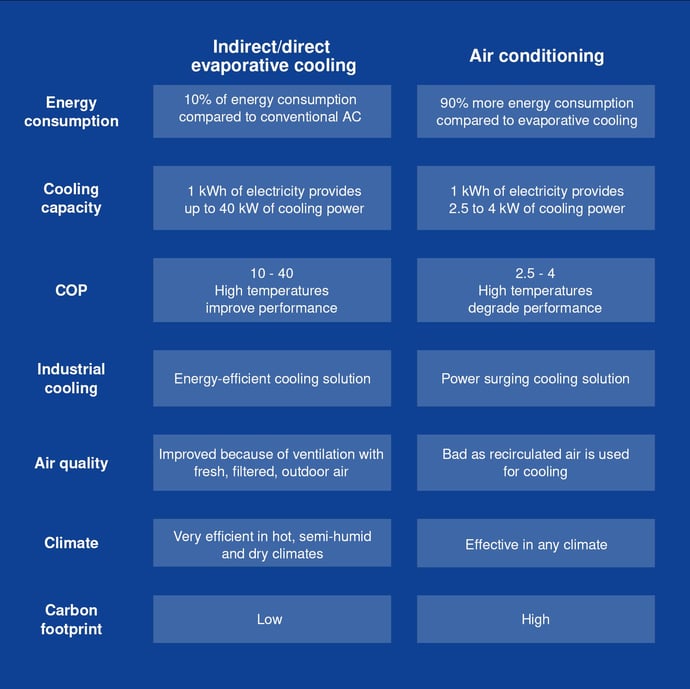
Figure: Comparison of indirect/direct evaporative cooling and conventional air conditioning, showing that evaporative cooling can use far less energy, deliver much higher cooling capacity per kWh and a higher COP, while also supporting lower carbon emissions and improved indoor air quality.
At Oxycom, we believe in customization
Our specialists analyze your situation, from hall construction to heat sources, and design a system that fits your production environment perfectly.
With our adiabatic cooling systems, we create an energy-efficient, healthy, and comfortable indoor climate, in summer and winter alike. With minimal environmental impact and a short payback period.
How does Oxycom's adiabatic cooling work?
Our technology uses the natural principle of evaporative cooling: Heat is extracted from the air by evaporating water. Without refrigerants and with very low energy consumption.
The power lies in the two-stage cooling process:
️1. Indirect cooling: Outside air is cooled via a heat exchanger, without adding moisture.
2. Direct cooling: The air is then cooled further by direct evaporation, for maximum temperature reduction.
This combination provides powerful, sustainable cooling, fresh air, and optimal comfort in industrial environments.
The solution for large, warm spaces
Factory halls are often large, high and difficult to cool with traditional systems.
Our technology performs optimally in these conditions thanks to:
-
Rapid removal of warm, polluted air.
- 100% fresh, filtered outside air.
Efficient cooling without draughts or dry air
The temperature in your hall can drop to 7–10 °C without refrigerants or compressors. In winter, the system can reuse heat and save up to 40% on heating costs.
Curious about what our solution can do for your factory?
Whether you are active in the metal industry, logistics or food production, a stable and healthy indoor climate is essential for continuity, productivity and satisfied employees. With Oxycom, you are choosing proven technology, sustainable savings and comfort in the workplace.
Request advice without obligation. We would be happy to show you how many degrees and pounds you can save.