/Logo%20Oxycom/Logo%20Oxycom%20-%20blue.png?width=207&name=Logo%20Oxycom%20-%20blue.png)



/Case%20studies%20(Pictures)/VCN/Oxycom%20-%20Clauger.jpg?width=900&height=900&name=Oxycom%20-%20Clauger.jpg)
/Case%20studies%20(Pictures)/Equinix/PreCooll%20adiabatisch.jpg?width=1400&height=1050&name=PreCooll%20adiabatisch.jpg)
Companies with older refrigeration systems are facing increasingly stringent regulations. Regulations on synthetic refrigerants are being tightened step by step, prices are rising and availability is decreasing. In practice, many companies wait until a system fails or an inspection forces them to act. With stricter refrigerant rules being introduced worldwide, waiting is no longer a wise option.
From R-22 to HFCs: regulations continue to tighten worldwide
R-22, an HCFC refrigerant that was widely used for many years in air conditioning and industrial cooling systems, may no longer be used for servicing or topping up refrigeration and air conditioning systems in the EU as of 1 January 2015. In accordance with the European Ozone Regulation, R-22 may no longer be replenished in any form in refrigeration and air conditioning systems as of Jan. 1, 2015. Many companies therefore switched to HFC refrigerants, which belong to the F-gases family. However, many HFCs have a high global warming potential.
International regulations on HFC refrigerants are also becoming stricter. The Kigali Amendment to the Montreal Protocol requires countries worldwide to gradually phase down the production and consumption of HFCs. In practice, this means that availability will decrease over time, while costs and compliance requirements may increase. Countries such as the United States, Canada, Australia and Japan are implementing their own rules and phase-down schedules. Although the exact requirements differ by country, the direction is the same: high-GWP synthetic refrigerants are becoming less attractive for long-term cooling investments.
Stricter oversight and higher maintenance costs
The regulations are not limited to the purchase of refrigerants. In many countries, installations with synthetic refrigerants are subject to mandatory leak checks, extensive logbooks and certification requirements for mechanics. The frequency of checks depends on the refrigerant charge, expressed in tons of CO₂ equivalent. The larger the charge and the higher the GWP, the more often the installation should be checked. GWP stands for Global Warming Potential. At the same time, grid congestion is playing an increasing role. Companies looking to expand or become more sustainable often encounter waiting lists for grid reinforcement. New, power-intensive chillers then no longer always fit the bill.
When companies really get moving
The urgency is usually only felt when a machine breaks down. Companies with installations that have been running on synthetic refrigerants for fifteen to twenty years must then choose: invest in an expensive repair of an outdated system with increasingly expensive refrigerants, or switch to a future-proof solution. Large companies also experience pressure from ESG reporting (sustainability reporting on the environment, people and governance) and CO₂ reduction targets. As a result, refrigerants with high global warming potential are becoming less and less acceptable.
Cooling with water evaporation instead of synthetic refrigerants
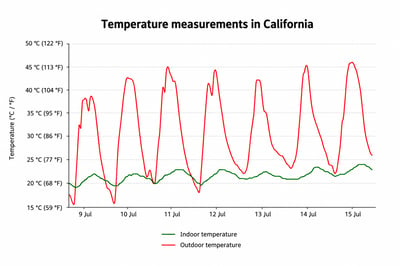
In the search for alternatives to synthetic refrigerants, more and more companies are looking at natural refrigerants and cooling principles with lower climate impact. Oxycom offers an alternative that does not rely on synthetic refrigerants: two-stage adiabatic cooling. The principle is simple: water evaporates and extracts heat from the air, no R-22, HFC or ammonia is involved. In the first stage, the process air is cooled indirectly through a heat exchanger, leaving the air dry. In the second stage, water evaporates directly into the pre-cooled air stream, lowering the temperature further. This system works effectively at high outdoor temperatures, especially when relative humidity is not extremely high.
Why adiabatic cooling is relevant to your business
No synthetic refrigerants, lower regulatory burden
Because Oxycom's systems do not use synthetic refrigerants, companies avoid many requirements linked to refrigerant handling, leakage control and HFC scarcity. No synthetic refrigerant circuit, no direct refrigerant leakage risk and no rising costs due to scarcity of HFC refrigerants.
Low energy consumption
Two-stage adiabatic cooling consumes up to 90 percent less energy than traditional mechanical cooling. This translates directly into lower energy costs and a lighter load on the power connection, which is especially important during grid congestion.
Maintenance by your own technical service
Due to the absence of a synthetic refrigerant circuit, regular technical skills are sufficient for maintenance; no special refrigerant certification is required. This gives companies more freedom to organize maintenance internally.
Future-proof refrigeration
With stricter international climate legislation, a system without synthetic refrigerants is the safest choice for the long term. Companies reduce their dependence on scarcity and price increases around synthetic refrigerants and reduce their carbon footprint.
Why cooling without synthetic refrigerants is becoming increasingly relevant
The global phase-down of HFCs and the earlier phase-out of R-22 are pushing the market in one direction. Therefore, the question is not only whether your current refrigeration system is future-proof, but also when switching makes the most financial and operational sense.
Want to know if two-stage adiabatic cooling is right for your building, process or cooling demand? Contact Oxycom for a no-obligation consultation.