/Logo%20Oxycom/Logo%20Oxycom%20-%20blue.png?width=207&name=Logo%20Oxycom%20-%20blue.png)



/Case%20studies%20(Pictures)/VCN/Oxycom%20-%20Clauger.jpg?width=900&height=900&name=Oxycom%20-%20Clauger.jpg)
/Case%20studies%20(Pictures)/Equinix/PreCooll%20adiabatisch.jpg?width=1400&height=1050&name=PreCooll%20adiabatisch.jpg)
More companies are running into the same problem: there is simply not enough electrical capacity available.
In many industrial areas, the power grid is under pressure. A 2026 report by Ember describes grid capacity limitations as a critical risk to Europe’s energy system. Even companies that want to expand production or add new equipment are often unable to get additional grid capacity. In more and more cases, connection requests can take years.
At the same time, electricity demand keeps growing. According to the International Energy Agency, global electricity consumption is expected to increase by around 3.6% every year through 2030. In Europe, this growth is being driven by industrial electrification, data centres, electric transport, and new production technologies.
The challenge is no longer only about generating more renewable energy. In many places, the electricity is available, but the grid cannot transport it fast enough. This creates congestion and limits industrial growth.
Why cooling matters more than ever
When companies think about reducing energy use, cooling systems are often overlooked. However, in industries such as manufacturing, logistics, and food processing, cooling represents a large and constant electrical load.
That makes cooling one of the fastest ways to free up energy capacity inside an existing facility. I often explain it very simply: if you reduce the energy demand of your cooling system, that electricity becomes available for production. That makes cooling efficiency not only an energy-saving measure, but also a way to increase usable production capacity within existing electrical limits. 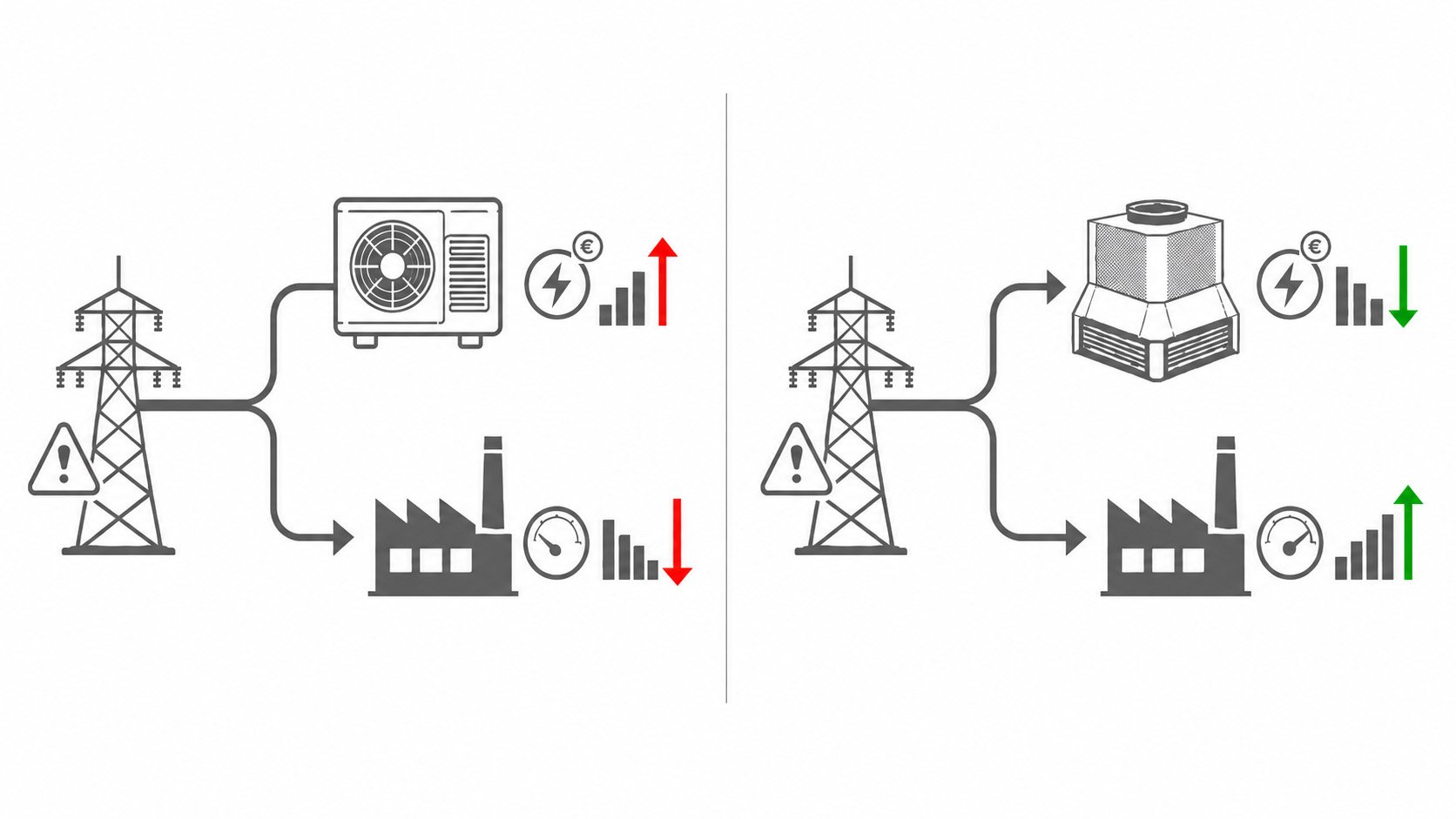
A different approach to industrial cooling
At Oxycom, we see this challenge more frequently, especially in highly industrialized regions. As Commercial Director and Technical Specialist, I see that the biggest issue is often not cost. It is that many companies simply do not know that alternatives exist.
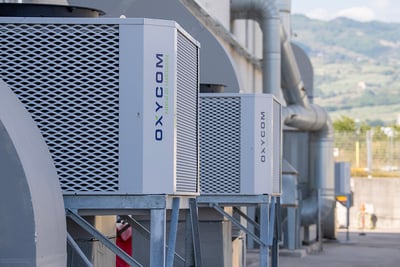
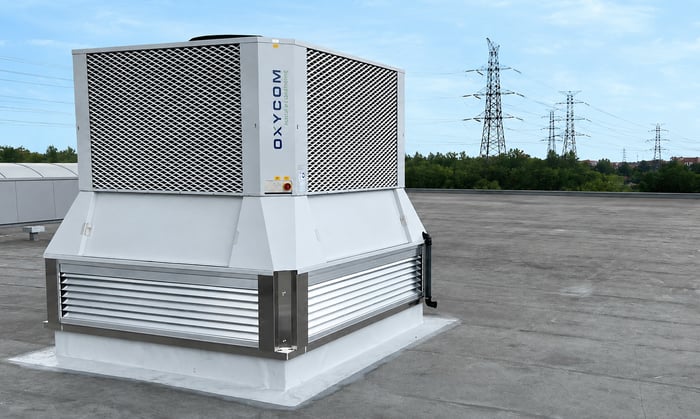
Traditional mechanical cooling systems consume large amounts of electricity. Two-stage adiabatic cooling works differently. Instead of relying on energy-intensive refrigeration cycles, systems like IntrCooll use water and airflow to cool industrial spaces much more efficiently.
Depending on the application and climate conditions, energy savings can reach up to 90% compared to conventional mechanical cooling. At the same time, stable indoor temperatures are maintained to support reliable production processes.
Stable temperatures support stable production
Temperature stability is critical in industrial environments. Fluctuations can lead to production errors, rejected products, and unnecessary waste. That is why cooling performance is directly connected to operational reliability. In my experience, this is often where the value becomes clear: stable cooling does not only reduce energy use, it also helps protect the production process itself.
With advanced two-stage adiabatic cooling, companies can maintain stable indoor conditions while significantly reducing electricity consumption. These systems operate with 100% fresh outside air, improving indoor air quality and oxygen levels while keeping relative humidity below 65%.
Another important advantage is sustainability. Water (R718) is used as the cooling medium, removing the need for chemical refrigerants.
Creating room for growth without expanding the grid
Grid congestion is becoming a long-term reality across Europe and increasingly in the United States as well.
In the U.S., more than 2,000 GW of energy projects are currently waiting in interconnection queues, with connection timelines often exceeding five years. This figure comes from data by Lawrence Berkeley National Laboratory and shows that grid congestion is not only a European issue. The same structural challenge is visible in the United States, where generation is growing faster than transmission infrastructure.
For many industrial companies, waiting for additional grid capacity is simply not a realistic short-term solution. That is why optimizing existing energy use is becoming more important.
By lowering the energy demand of non-core systems such as cooling, companies can create more room for production within the same electrical limits. This improves operational flexibility while helping facilities prepare for future growth.
Looking ahead
The pressure on electricity grids will continue to grow as temperatures rise, industries electrify, and energy demand increases.
In this environment, smarter cooling systems can play an important role. Advanced two-stage adiabatic cooling offers a practical way to reduce energy consumption, maintain reliable indoor conditions, and unlock hidden production capacity. For companies facing grid limitations, cooling optimization is no longer just an efficiency upgrade. It is becoming part of a long-term operational strategy.
If you want to explore how more efficient cooling can free up electrical capacity for production, contact the Oxycom team to identify opportunities within your facility.