/Logo%20Oxycom/Logo%20Oxycom%20-%20blue.png?width=207&name=Logo%20Oxycom%20-%20blue.png)



/Case%20studies%20(Pictures)/VCN/Oxycom%20-%20Clauger.jpg?width=900&height=900&name=Oxycom%20-%20Clauger.jpg)
/Case%20studies%20(Pictures)/Equinix/PreCooll%20adiabatisch.jpg?width=1400&height=1050&name=PreCooll%20adiabatisch.jpg)
/Case%20studies%20(Pictures)/Equinix/Equinix%20Amsterdam%20.jpg?width=700&name=Equinix%20Amsterdam%20.jpg)
Data centers are the backbone of our digital world. From AI applications to cloud platforms and streaming services, without data centers, everything comes to a standstill. At the same time, their impact is rapidly growing, both in terms of energy consumption and their effect on the surrounding environment.
Rising energy demand from data centers
Data centers have become some of the largest energy consumers in the digital economy. According to the International Energy Agency (IEA), they account for approximately 1–1.5% of global electricity use, with significantly higher concentrations in major data hub regions.
With the explosive growth of AI, cloud computing, and digital services, electricity demand is expected to rise sharply in the coming years.
This is putting increasing pressure on power grids. In several regions, particularly in parts of the United States and Europe, grid capacity is becoming a limiting factor, delaying new developments or requiring major infrastructure upgrades.
New insights: data centers as heat islands
Beyond energy consumption, there is another, less visible but potentially significant challenge: heat.
Recent research show that data centers can create localized “heat island” effects. The large amounts of energy they consume are ultimately released as heat, raising temperatures in surrounding areas:
-
Average increase: +2°C (≈3.6°F)
-
In extreme cases: up to +9°C (≈16°F)
-
Impact detectable up to 10 km (≈6 miles) away
These temperature increases are independent of broader climate change and are directly linked to the presence of data centers.
As AI infrastructure continues to scale rapidly, this effect is expected to intensify, impacting livability, energy demand, and even local economies.
Growing concerns in the United States
In the United States, the rapid expansion of hyperscale data centers has sparked increasing public debate.
In regions such as Northern Virginia, Texas, and Arizona, major data center hubs, concerns are growing around:
-
Rising electricity demand and grid strain
-
Limited space for other developments
In some cases, new projects have faced delays, stricter regulations, or public opposition due to their impact on infrastructure and the environment.
This highlights a broader global challenge: how to support digital growth without overwhelming local resources.
Smarter cooling: the role of adiabatic pre-cooling
One of the most effective ways to address this problem is adiabatic pre-cooling of data centers.
Instead of relying solely on mechanical cooling, outside air is pre-cooled naturally through evaporation before entering the system. This significantly reduces the workload on chillers.
The result:
-
Lower energy demand
-
Improved performance in high temperatures
-
Reduced peak load
-
Less heat rejection into the surrounding environment
From theory to practice: Equinix data centers
The effectiveness of this approach is demonstrated in a real-world case with Equinix, one of the world’s largest data center operators.
During the development of new facilities, Equinix faced strict power limitations. Every additional kilowatt used for cooling would directly reduce available server capacity.
The challenge was clear: increase capacity without increasing energy consumption.
In collaboration with Trane, they implemented adiabatic pre-cooling using the PreCooll system.
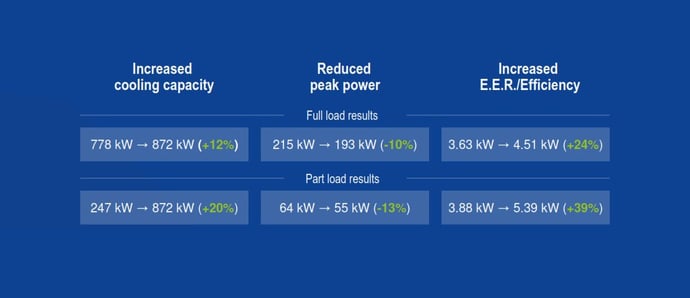 The solution was extensively tested under extreme conditions, exceeded expectations and led Equinix to adopt the PreCooll system at other locations.
Results:
- Up to 13% reduction in peak power demand
- Up to 20% increase in cooling capacity
- Up to 39% energy savings
- Significant increase in server capacity
By pre-cooling outside air by up to 25°C (≈45°F), chillers operate more efficiently, even during hot periods. This enabled higher server density without increasing grid load and extended chiller lifespan.
Conclusion: growth requires smarter choices
The impact of data centers extends far beyond energy consumption alone. Grid congestion and local heating are making efficiency more critical than ever. Smarter cooling solutions play a key role in enabling continued growth with less environmental impact.
Curious what this could mean for your data center? We’re happy to explore optimization opportunities in your cooling system.