/Logo%20Oxycom/Logo%20Oxycom%20-%20blue.png?width=207&name=Logo%20Oxycom%20-%20blue.png)



/Case%20studies%20(Pictures)/VCN/Oxycom%20-%20Clauger.jpg?width=900&height=900&name=Oxycom%20-%20Clauger.jpg)
/Case%20studies%20(Pictures)/Equinix/PreCooll%20adiabatisch.jpg?width=1400&height=1050&name=PreCooll%20adiabatisch.jpg)
ESG (Environmental, Social and Governance) requirements are becoming increasingly specific. Customers, investors and auditors are demanding demonstrable evidence of sustainable performance. At the same time, you want to keep energy costs under control and ensure a healthy and pleasant working environment in your factory.
Sustainability certificates help to make that performance measurable and substantiated. They demonstrate how energy-efficient, healthy and future-proof your factory premises are. This provides a solid basis for audits, tenders and investment decisions.
What is the added value of a sustainability certificate?
A certificate is more than just a label. It acts as a benchmark and as proof for stakeholders such as shareholders. Certification makes performance transparent and helps to focus efforts on improvement.
What are the concrete benefits of a sustainability certificate?
- Lower energy consumption through smarter design and management of systems;
- Improved comfort and indoor climate, noticeable to staff;
- Demonstrable sustainability to customers, investors and regulators;
- Added value and enhanced appeal of your property.
BREEAM: widely recognised and internationally accepted
Are you looking for a certificate that is widely recognised, including internationally? Then BREEAM is often the first option that comes to mind. BREEAM (Building Research Establishment Environmental Assessment Method) is one of the most widely used assessment methods worldwide. In the Netherlands, the Dutch Green Building Council administers the certification scheme.
There are specific guidelines for industrial buildings, for example for existing properties or for new builds and renovations. BREEAM assesses a range of areas, such as:
- Energy consumption
- Materials
- Water
- Waste
- Transport
- Ecology
- Health
When is BREEAM appropriate?
BREEAM is particularly suitable for industrial companies wishing to provide broad evidence of their sustainability efforts, for example in a tender process or when collaborating with major (international) clients.
The M&G project in Assen demonstrates how Oxycom contributes to BREEAM-certified buildings through sustainable climate control. In this video, Kor Foekens, Commercial Director at Oxycom, tells us more about this project.
Focus on people and the working environment with WELL
Do you want to better safeguard the well-being, health and productivity of your employees? Then you can aim for WELL certification. WELL is well-known in office environments, but is increasingly being applied in industrial buildings. The focus is less on energy consumption and more on how people experience the building.
For example, WELL looks at:
- Air quality
- Daylight and lighting
- Acoustics
- Thermal comfort
The effect is often immediately noticeable. A stable and comfortable indoor climate helps staff perform better and contributes to attracting and retaining staff.
A practical example where Oxycom has contributed to air quality and thermal comfort is PERFECT - Van Wamel. In their production halls, Oxycom’s innovative adiabatic cooling systems ensured a significantly lower temperature, lower concentrations of welding fumes and a substantial reduction in energy costs. These improved working conditions were immediately noticed by employees. “Employees no longer want to go home in the evenings during the summer, because it’s so pleasantly cool inside.
/Book%20cover%20pictures%20(whitepapers%20and%20case%20studies)/NL/PERFECT%20-%20Van%20Wamel/PERFECT-VanWamel_Small_NL.png?width=159&height=222&name=PERFECT-VanWamel_Small_NL.png)
“Employees no longer want to go home in the evenings during the summer, because it’s so pleasantly cool inside.” - Johan van der Markt, PERFECT – Van Wamel

Demonstrating sustainability with LEED
Do you want to demonstrate internationally how sustainable your building is? Then certification under LEED (Leadership in Energy and Environmental Design) could be the solution. LEED is a globally recognised standard for assessing sustainable buildings. Offices, homes and factories alike can use it to demonstrate how energy-efficient and environmentally friendly they are.
Under the LEED scheme, buildings earn points across various categories, such as energy use, material use, water consumption and indoor environmental quality. Based on the number of points, a building is awarded a certification level, ranging from Certified to Platinum. In this way, LEED makes sustainability measurable and helps organisations to substantiate sustainable choices in the design and use of buildings.
Energy-efficient climate control systems often play a key role in this. Systems such as the IntrCooll contribute to lower energy consumption and a healthy indoor climate. By using water as a refrigerant, employing CO₂-controlled ventilation and being able to reuse heat, these systems can contribute to a higher LEED score.
Demonstrate your impact with the IntrCooll
Certification requires well-founded choices. In industrial buildings, climate control systems often account for a large proportion of energy consumption and comfort. The right cooling/ventilation strategy can therefore have a significant impact on your sustainability narrative.
Indirect/direct two-stage adiabatic cooling, such as Oxycom’s IntrCooll, has been developed to cool industrial spaces energy-efficiently whilst simultaneously improving thermal comfort. Depending on the application and conditions, this can lead to
- Significantly lower electricity consumption for cooling
- Lower CO₂ emissions
- Lower cooling costs in summer
- Complete elimination of climate-damaging refrigerants
- A pleasant working environment for staff

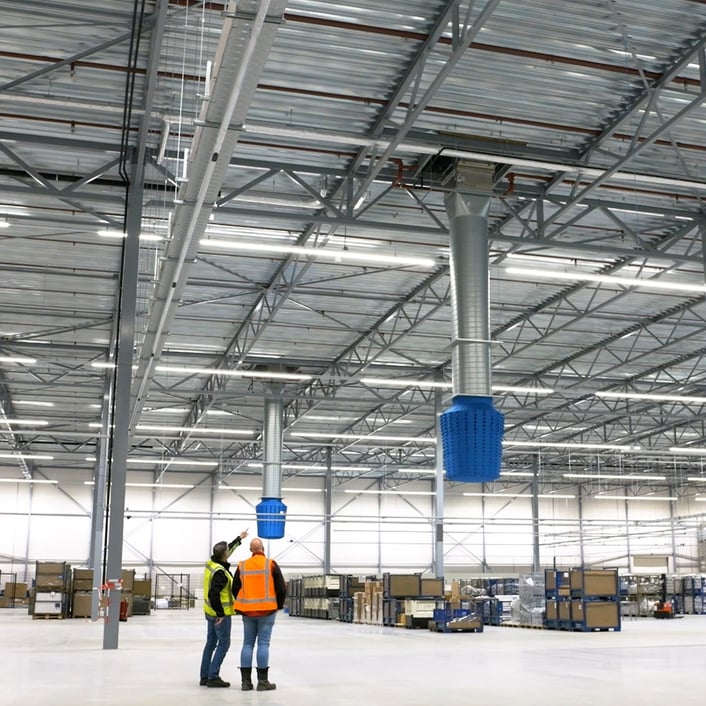
Every factory is different. Nevertheless, there are often opportunities in terms of energy efficiency, comfort and supporting documentation for BREEAM, WELL and LEED.
Would you like to know how Oxycom’s IntrCooll can contribute to your certification and sustainability goals?
Contact our experts and discover the possibilities for your premises.