/Logo%20Oxycom/Logo%20Oxycom%20-%20blue.png?width=207&name=Logo%20Oxycom%20-%20blue.png)



/Case%20studies%20(Pictures)/VCN/Oxycom%20-%20Clauger.jpg?width=900&height=900&name=Oxycom%20-%20Clauger.jpg)
/Case%20studies%20(Pictures)/Equinix/PreCooll%20adiabatisch.jpg?width=1400&height=1050&name=PreCooll%20adiabatisch.jpg)
Evaporative cooling
/Case%20studies%20(Pictures)/Pilomat/Pilomat_web2.jpg?width=1080&name=Pilomat_web2.jpg)
How Oxycom’s two-stage adiabatic cooling technology helped create an energy-efficient foundation for year-round climate control at Pilomat in Bergamo.
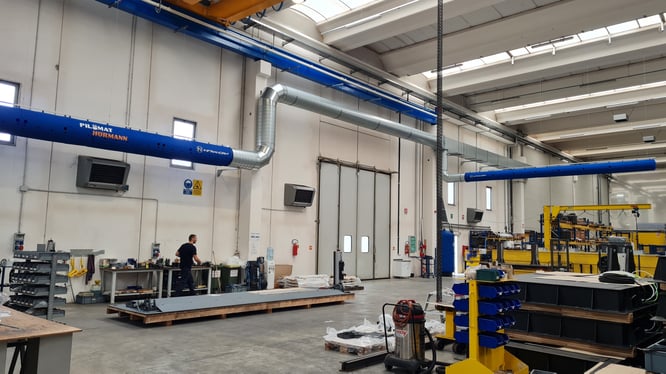
Pilomat s.r.l. is an Italian manufacturer of automatic access control and perimeter security solutions. The company is known for automatic bollards and access control systems for industrial, commercial and public environments. Pilomat is part of the Hörmann Group.
Pilomat needed reliable indoor climate conditions in two production areas throughout the year. In summer, temperatures in the working areas increased significantly. At the same time, the available electrical capacity at the site was limited.
A conventional cooling concept based mainly on compressor technology would have increased peak electricity demand. Pilomat therefore needed a cooling strategy that could deliver effective temperature reduction while staying within the limits of the existing electrical infrastructure.
/Case%20studies%20(Pictures)/Pilomat/Pilomat%20Intrcooll%20two-stage%20adiabatic%20cooling.jpg?width=666&height=444&name=Pilomat%20Intrcooll%20two-stage%20adiabatic%20cooling.jpg)
Oxycom’s IntrCooll forms the energy-efficient cooling basis of the installation. The system uses two-stage adiabatic cooling technology to cool large volumes of fresh air with low electrical energy consumption. This reduces reliance on active mechanical cooling. During extremely high outdoor temperatures or peak loads, two heat pumps provide an additional layer of cooling capacity when required. In winter, these heat pumps are also used for heating.
An identical installation with a fresh air capacity of 28,000 m³/h was implemented for each production zone. Within these installations, IntrCooll provides the two-stage adiabatic base cooling.
In industrial halls, high internal heat loads and large air volumes can make conventional cooling energy-intensive. Oxycom’s two-stage adiabatic technology delivers high-volume fresh-air cooling with low electrical input, helping create stable indoor conditions in demanding production environments.
This gives Pilomat an efficient cooling concept that combines strong airflow performance with reduced electrical demand.
The installation helps Pilomat create more stable indoor conditions in two production areas while limiting the demand for active mechanical cooling.
Hybrid operation combining two-stage adiabatic cooling with active cooling via two reversible heat pumps
Energy-efficient base cooling using Oxycom’s two-stage adiabatic technology
High fresh air capacity of 56,000 m³/h, distributed across two zones
Reduced reliance on compressor-based cooling under normal cooling conditions
Lower peak electrical demand than with a fully compressor-based cooling concept
Stable indoor climate control for production areas with limited electrical capacity
/Case%20studies%20(Pictures)/Pilomat/Pilomat_web2.jpg?width=1613&height=907&name=Pilomat_web2.jpg)
The Pilomat project demonstrates how Oxycom technology can make industrial cooling feasible where electrical capacity is limited.
By using IntrCooll two-stage adiabatic cooling, large production areas can be supplied with cooled fresh air at low electrical input.
For industrial facilities facing rising cooling demand, limited grid capacity or pressure to reduce energy use, Oxycom provides a practical route to more efficient hall climate control.