/Logo%20Oxycom/Logo%20Oxycom%20-%20blue.png?width=207&name=Logo%20Oxycom%20-%20blue.png)



/Case%20studies%20(Pictures)/VCN/Oxycom%20-%20Clauger.jpg?width=900&height=900&name=Oxycom%20-%20Clauger.jpg)
/Case%20studies%20(Pictures)/Equinix/PreCooll%20adiabatisch.jpg?width=1400&height=1050&name=PreCooll%20adiabatisch.jpg)
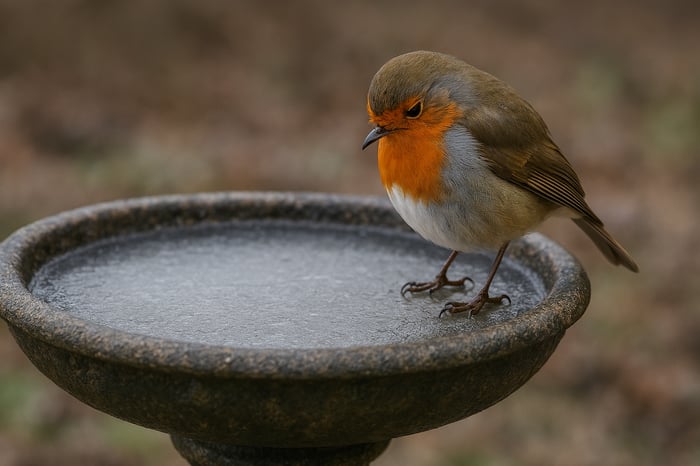
Bird baths are useful to help birds stay hydrated when it’s hard to find drinking water, for instance during hot summers or cold winters. They can be equipped with heating elements to prevent them from freezing in the winter. But that’s only useful at sub-zero temperatures... or is it?
An example comes from the “science” of bird baths. It has been studied that on days where the outdoor temperature never dropped below 4 °C (39.2 °F), the surface of the water still froze, leaving the poor birds not just cold but also thirsty. Surprisingly, the question of how water could freeze above its melting temperature can be answered by explaining how it can evaporate below its boiling point, two seemingly unrelated phenomena!
Evaporation below 100 °C (212 °F)
In a previous article we talked about water being one of nature’s most powerful refrigerants. Of all liquids it has the highest latent heat of vaporization, meaning it takes more energy than any other liquid to break the bonds between the molecules to transform liquid water into water vapor. While it only takes about 4.2 kJ of heat to increase the temperature of one liter of water by one degree (let’s say from 99 °C (210.2 °F) to 100 °C (212 °F), its well known boiling point at sea level), more than 500 times this amount of heat is required to evaporate the same amount of water: 2256 kJ/kg!
But what many people may not realize is that you don’t have to bring water to the boil to turn it into a vapor. It’s just that water behaves like it doesn’t have a choice other than to evaporate when it is heated to 100 °C (212 °F) . But it can perfectly well evaporate at much lower temperatures, as long as it is forced to do so. And it makes sense if you think of it: if you let your freshly washed laundry hang to dry it will be ready in a couple of days, and of course, Oxycom's IntrCooll and PreCooll make use of the evaporation principle to cool down the air; in neither case the water involved has to be heated all the way to 100 °C (212 °F) .
How humidity influences evaporation
The question then is: how do you force water to evaporate already at room temperature? That’s in fact quite simple: by making use of the fact that nature doesn’t seem to like abrupt changes – so not unlike human beings. Liquid water consists of densely packed water molecules that are still free to move around one another. Air, on the other hand, is a gas that mainly consists of freely moving nitrogen and oxygen molecules, and about a percent of other molecules like argon and carbon dioxide; this mixture is called dry air. It can also contain a small amount of water vapor, typically in the order of one percent; the mixture of dry air and water vapor is called humid air.
You can simply think of water as “lots of water molecules” and of humid air as “very few water molecules”.
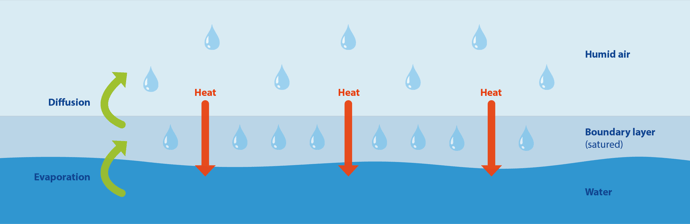
When water is exposed to air there is a very sharp transition between lots of and very few water molecules, which, not liked by nature, is made smoother by the formation of a boundary layer in between. This boundary layer is still humid air, but now fully saturated, meaning it holds as much water vapor as it possibly can at a given temperature. It can be seen as some kind of average of the layer of liquid water and the surrounding unsaturated humid air, helping to put nature’s mind at ease, so to speak.
Diffusion and airflow
Then another natural phenomenon is starting to play a role. Just as objects always fall down and never up, and cables always tend to get tangled but never untangle themself, water vapor will move from places of high concentration (the boundary layer) to places of low concentration (the humid air) – a process called diffusion. This will occur by itself, but can be sped up greatly by using a fan to force air flowing over the surface of water.
The result is that this air becomes more humid, but at the cost of the boundary layer getting depleted from water vapor. Nature reacts once again by turning liquid water into water vapor to restore the original saturated state of the boundary layer. But remember that this transition requires lots of energy, which is taken from the air itself. The air not only becomes more humid but also cools down!
Humidity and temperature drop
Whether at room temperature, close to the freezing point of water or more towards its boiling point, this process will occur at any given temperature. It is even more efficient at room temperature than at the boiling point, because of the higher latent heat of vaporization: 2454 kJ/kg at 20 °C (68 °F). It means that for every 1 g/kg increase in absolute humidity caused by forced evaporation, the temperature drops by about 2.5 °C (4.5 °F). This process will go on until the air becomes fully saturated and cannot hold any more water. The temperature that the air has reached by then is called the wet bulb temperature, which is the lowest temperature possible by means of evaporation. By the way, the IntrCooll uses a clever technique to seemingly trick nature and cools down air to below the wet bulb temperature, but that is perhaps a story for another time.
Understanding wet bulb temperature
The term wet bulb temperature may not ring a bell with everyone, but you can take the name literally. An old-fashioned liquid-in-glass thermometer has a bulb at the bottom filled with alcohol that expands upon temperature increase. The reading on the thermometer is what we call temperature, but strictly speaking it is the dry bulb temperature. If we cover this bulb with a cloth that is soaked with water (wet bulb!), and to help the process we blow some air around it, the thermometer will show us a lower value: the wet bulb temperature.
Subconsciously we are all familiar with the wet bulb temperature. Step out of the shower or a swimming pool, and suddenly it feels a lot colder: the induced evaporation extracts heat from your skin, and what you experience is the wet bulb temperature. But contrary to the apparent temperature (which is the temperature perceived by humans, based on the wind chill factor, and therefore subjective by definition), the wet bulb temperature is a real physical quantity that can be measured objectively.
Why a bird bath freezes above 0 °C (32 °F)
Now we are ready to return to our bird bath example. It turned out that although the dry bulb temperature was recorded to be above 0 °C (32 °F) the entire day, thus continuously above the freezing point, it was the wet bulb temperature at the water/air interface that dropped below zero and caused the bird bath to freeze. Still thirsty birds, unfortunately, but intriguing science!