/Logo%20Oxycom/Logo%20Oxycom%20-%20blue.png?width=207&name=Logo%20Oxycom%20-%20blue.png)



/Case%20studies%20(Pictures)/VCN/Oxycom%20-%20Clauger.jpg?width=900&height=900&name=Oxycom%20-%20Clauger.jpg)
/Case%20studies%20(Pictures)/Equinix/PreCooll%20adiabatisch.jpg?width=1400&height=1050&name=PreCooll%20adiabatisch.jpg)
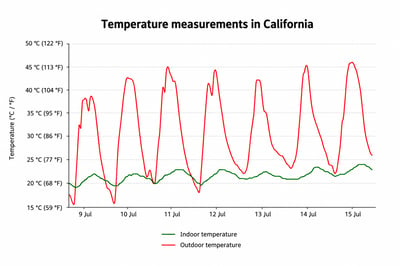
On hot days, temperatures in production facilities rise rapidly. Machines and processes continuously generate heat, while sunlight further heats the roof. Meanwhile, employees need to stay focused and work safely. This is more than just a summer comfort issue.
Recent research by the World Health Organization (WHO) and World Meteorological Organization (WMO) shows that more than 2.4 billion workers worldwide are exposed to excessive heat. More than one third of people who regularly work in hot conditions experience physiological heat strain, while around 30 percent report heat-related productivity losses.
Heat therefore affects not only employee health and safety, but also productivity and business continuity.
When is it too hot to work?
There is no universal maximum workplace temperature that applies across countries. In the United States, OSHA states that employers are responsible for protecting workers from hazardous heat exposure. In the United Kingdom, the Health and Safety Executive (HSE) does not set a legal maximum workplace temperature, but requires employers to assess and manage heat-related health and safety risks. Whether conditions are too hot depends on several factors, including humidity, air movement, radiant heat, clothing, and physical workload.
In production facilities, there are often additional heat sources, such as machines, ovens, lasers, compressors, hot products, and solar radiation through the roof and facade.
A heat action plan is therefore essential. 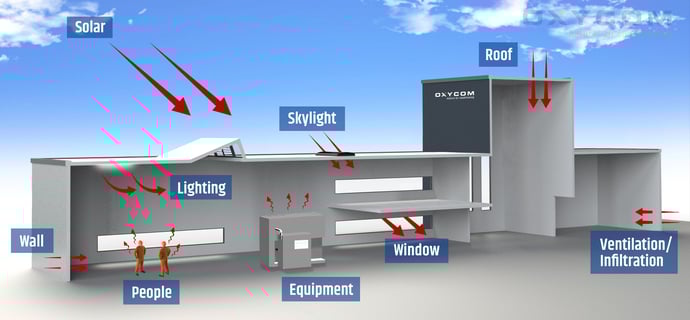
Figure: Heat sources in an industrial building. The red arrows show how heat enters or is generated inside the building: through solar radiation, the roof, skylights, windows and walls, and from internal sources such as lighting, people and machinery. Ventilation and infiltration of warm outside air also add to the heat load.
How do you protect employees from heat?
Summers are getting hotter, and periods of extreme heat are becoming more frequent. As a result, heat stress in production facilities is also increasing. Organizational measures are necessary to ensure employees can work safely and in good health.
Consider:
• a practical heat action plan;
• sufficient drinking water and extra breaks;
• adjusted work tasks or work schedules;
• limiting physical exertion during the hottest parts of the day.
These measures help minimize risks to employees but also have implications for business operations. Additional breaks, adjusted work schedules, and reduced production capacity can lower productivity and increase operating costs.
Technical measures reduce reliance on organizational measures. By exhausting hot air, ensuring adequate ventilation, and effectively cooling the work area, the indoor climate remains comfortable. As a result, extra breaks, adjusted working hours, or changes to production are needed less often, or may not be necessary at all, allowing production to continue even during periods of extreme heat.
When heat stress poses a potential workplace risk, it should be included in the organization’s overall risk assessment. Guidance from the International Labour Organization (ILO), EU-OSHA and OSHA highlights factors such as air temperature, humidity, radiant heat, air movement, physical workload and protective clothing. Appropriate measures should then be taken to reduce worker exposure.
Why ventilation alone is not enough
Ventilation helps remove hot and contaminated air from the production facility. On hot days, however, this alone is not sufficient to create a comfortable working environment, because the incoming outdoor air is also hot.
Furthermore, opening doors and gates isn’t always possible, for example, due to noise pollution, safety requirements, or company protocols.
An effective long-term climate solution must therefore do three things:
- Exhaust hot and contaminated air.
- Supply fresh outside air.
- Cool the incoming outdoor air before it reaches the production area.
For production facilities with a high internal heat load, a system that combines ventilation and cooling is therefore essential. Two-stage adiabatic cooling provides an energy-efficient solution.
How does two-stage adiabatic cooling work?
In direct adiabatic cooling, warm outdoor air is cooled in a single step through water evaporation. This can lower the temperature of the outdoor air by up to 10°C.
Two-stage adiabatic cooling goes one step further. Oxycom’s IntrCooll first cools the outdoor air indirectly, without adding moisture. The air is then further cooled in a second, direct step through water evaporation.
Thanks to this combination, IntrCooll can cool the air 4 to 7°C (7.2 to 12.6°F) further than direct adiabatic cooling, while adding approximately half as much moisture to the supply air. During hot periods, IntrCooll cools and ventilates the production facility with 100 percent fresh, filtered outdoor air.
Up to 90 percent lower energy consumption
IntrCooll can consume up to 90 percent less energy than traditional air conditioning. The actual savings depend on the building, the internal heat load, operating hours, and the system with which it is compared.
The fact that such savings are achievable in practice is demonstrated at Sinnack Backspezialitäten. A total of 26 IntrCooll units have been installed across three production sites. According to Technical Director Peter Röskenbleck, this allows the company to save 90 percent on its energy bill.
Low energy consumption isn’t just relevant to operating costs. Due to grid congestion, the available electrical capacity at a facility is becoming increasingly important. The less power cooling requires, the more capacity remains available for machinery, production lines, and electrification.
Results in practice
Ultimately, technology must prove itself in practice, not just through calculations and technical specifications, but above all through what employees experience on a daily basis.
At VM Fijnmetaal, the Oxycom system has now been in operation for some time. According to Michel van Meurs, the results are clearly “visible and noticeable.” He cites consistent air quality, stable temperature control, and greater comfort for employees. He adds that the improved indoor climate also supports efficient production.
Two-stage adiabatic cooling has also proven its value at Heemskerk Fijnmechanica. The CNC milling and turning machines there generate a high internal heat load. On extremely hot days, two IntrCooll units lowered the temperature by up to 14°C (25.2°F), according to owner Lucien Heemskerk. He describes the system as environmentally friendly and energy-efficient and emphasizes the pleasant working environment for his employees.
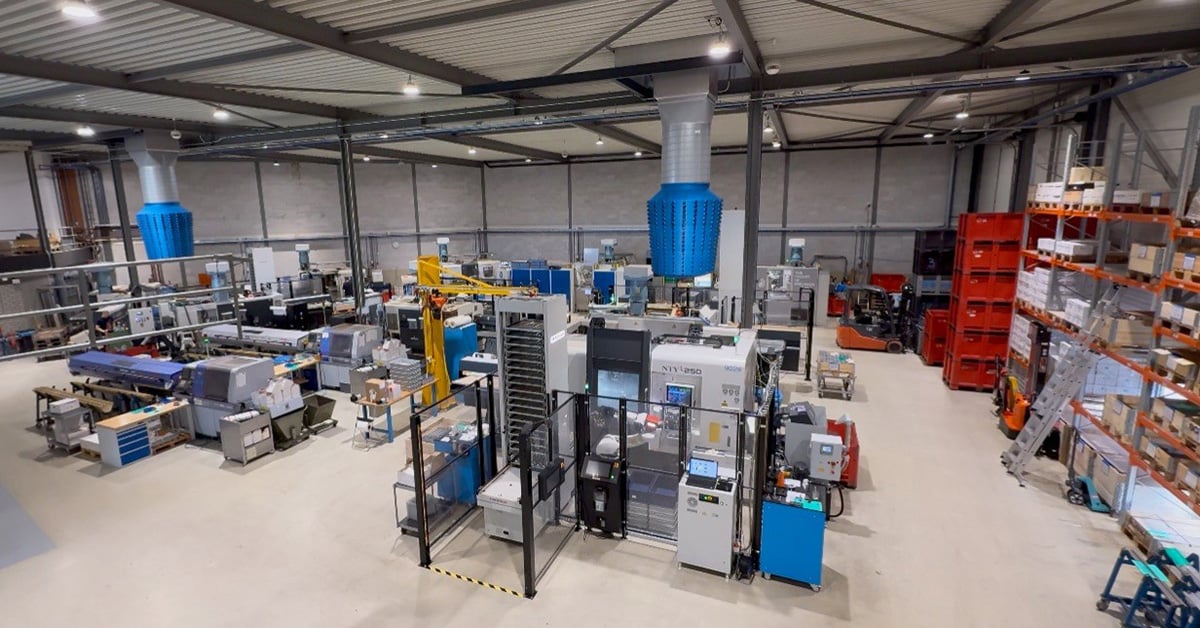
At 247TailorSteel, IntrCooll units are used for cooling, ventilation, heat recovery, and heating. The climate control concept is now implemented at all production sites.
That real-world proof is important: a climate control system must not only be efficient on paper but also make a noticeable daily contribution to a more comfortable and stable working environment.
From a heat action plan to a long-term solution
A cooling system does not replace a sound occupational health and safety policy, but it can reduce the need for organizational measures during periods of extreme heat. By continuously removing excess heat and cooling the work area, indoor conditions remain more stable even during hot periods.
Recent WHO and WMO findings show that heat in the workplace is not just a comfort issue. It affects health, safety, productivity, and business continuity.
How well is your production facility prepared for hot days?
Do you know where the largest heat sources are located, how air flows through your hall, and how much cooling capacity is actually needed?
Have the heat load, airflows, and cooling requirements of your production facility analyzed. This will give you insight into which climate solution is technically and economically suited to your building, production process, and sustainability goals.
Discuss your production facility’s cooling requirements with one of our cooling experts. Request a free consultation.